How retatrutide’s triple GIP/GLP-1/glucagon mechanism works, and the full TRIUMPH Phase 3 trial data behind it.
What it is studied for
- Activates three receptors at once — GIP, GLP-1 and glucagon — beyond what any dual agonist targets
- 28.7% mean body-weight loss at 68 weeks, 12 mg dose — the highest yet recorded in a Phase 3 obesity trial (TRIUMPH-4)
- ~75% reduction in knee pain among the TRIUMPH-4 knee-osteoarthritis trial population
- Glucagon-receptor activity adds liver-fat and energy-expenditure research on top of the GLP-1 effect
- Glycaemic-marker research in Phase 2 type 2 diabetes trials
Areas of published research interest. Not claims of effect, and not medical guidance.
What it is
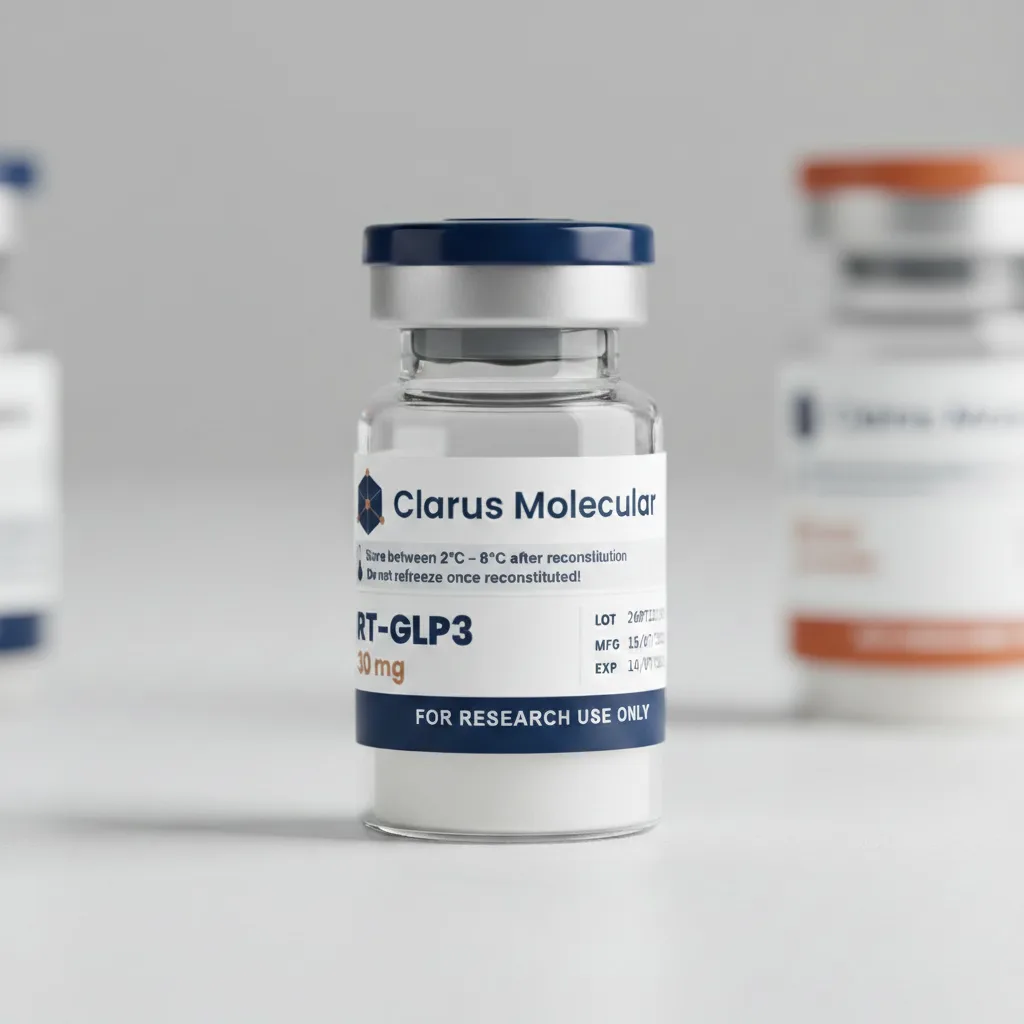
RT-GLP3 is our coded name for Retatrutide (Eli Lilly LY3437943), an investigational triple-receptor research peptide that activates the GIP, GLP-1 and glucagon receptors in a single molecule — a third receptor beyond what dual agonists like tirzepatide target, and the mechanism researchers credit for the compound's results in trials to date.
Structurally, retatrutide is a synthetic peptide of around 39 amino acids built on the same GIP-based backbone as tirzepatide, with an alpha-aminoisobutyric acid (Aib) substitution at position 2 for DPP-4 resistance. A C18 fatty-diacid chain, conjugated at a lysine residue, gives the molecule its long research half-life of approximately 6 days by enabling reversible binding to serum albumin — the same design principle behind once-weekly dosing across this drug class, and why the TRIUMPH trials dose it on a weekly schedule rather than daily.
In the research literature
Each of the three receptors contributes a distinct, separately studied mechanism (Coskun et al., 2022, Molecular Metabolism, preclinical characterisation). GIP receptor agonism enhances glucose-dependent insulin secretion, promotes pancreatic beta-cell survival in preclinical work, and may improve lipid metabolism. GLP-1 receptor agonism provides appetite suppression through central hypothalamic and brainstem signalling, delays gastric emptying, and enhances glucose-dependent insulin secretion — the same receptor that established therapies like semaglutide and liraglutide target on their own. Glucagon receptor agonism is retatrutide's defining, genuinely novel addition: it stimulates hepatic glucose production and increases hepatic lipid oxidation and fatty-acid beta-oxidation, promoting thermogenesis and energy expenditure.
Glucagon receptor activity in isolation would be expected to raise blood glucose, but the effect is reported to be counterbalanced by the simultaneous GLP-1 and GIP receptor activation, so the net metabolic result described in the research is a favourable glucose profile combined with increased energy expenditure and enhanced hepatic fat clearance. This is the mechanism researchers point to when explaining why retatrutide has outperformed single- and dual-agonist compounds on weight-loss endpoints in trials reported to date — though as an investigational compound, the full characterisation of its receptor pharmacology and how it translates to long-term clinical outcomes remains a question the Phase 3 program exists to answer.
Retatrutide and tirzepatide are close structural relatives — both roughly 39-amino-acid, GIP-backboned, Aib-stabilised peptides from the same manufacturer, both dosed once weekly. The two differ in exactly the place that matters mechanistically: tirzepatide carries a C20 fatty diacid at a different lysine position and has negligible glucagon-receptor activity, while retatrutide's C18 fatty diacid leaves room for potent glucagon agonism alongside GLP-1 and GIP. That one structural difference is the entire basis for retatrutide being studied as a triple agonist rather than a dual one. See our Tirzepatide research profile for the equivalent breakdown of that compound.
Retatrutide is in Phase 3 development under the TRIUMPH program: four trials enrolling roughly 5,800 participants in total, all testing 9 mg and 12 mg doses against placebo, with escalation starting at a 2 mg weekly dose. TRIUMPH-4 was the first to report, in December 2025 (Giblin K et al., Diabetes, Obesity and Metabolism 2026; PMID 41090431), enrolling 445 adults with obesity and knee osteoarthritis. At 68 weeks the 12 mg dose produced 28.7% mean body-weight loss (32.3 kg / 71.2 lb) and the 9 mg dose 26.4% (29.1 kg / 64.2 lb), against 2.1% on placebo — the highest weight-loss figure yet reported in a Phase 3 obesity trial for any compound. 58.6% of participants on the 12 mg dose achieved at least 25% weight loss, and 39.4% achieved at least 30%. The same trial recorded roughly 75% WOMAC knee-pain reduction at both doses and a 14.0 mmHg reduction in systolic blood pressure at the 12 mg dose.
Three further TRIUMPH readouts are expected through 2026. TRIUMPH-1 is an 80-week trial in general obesity, longer than TRIUMPH-4's 68 weeks, testing whether mean weight loss can exceed 30%. TRIUMPH-2 studies obesity alongside type 2 diabetes, tracking glycaemic control as well as weight. TRIUMPH-3 studies obesity alongside cardiovascular disease, tracking cardiovascular outcomes over the same window. A further trial in the program is tracking liver fat and other metabolic-health markers over a variable duration.
Phase 2 data preceded all of this and is what the Phase 3 program was built to confirm at scale: a 2023 trial (Jastreboff AM et al., N Engl J Med; PMID 37366315) reported up to 24.2% weight loss at 48 weeks, and a companion Phase 2 trial in type 2 diabetes (Rosenstock J et al., Lancet; PMID 37385280) studied the compound's glycaemic effects separately from its weight effects.
Retatrutide remains investigational and is not approved by the FDA, the NPRA, or any regulator, in Malaysia or elsewhere.
What to look for when sourcing
Retatrutide is stocked and dispatched from Klang Valley, Malaysia — orders confirmed before the daily cutoff ship the same business day, with Klang Valley addresses typically receiving delivery in 1–2 business days. Every currently published dose is priced and stocked live on the Retatrutide product page, where the current price and stock status for each size is always live rather than a figure that can go stale in an article.
Ask any supplier for an independent Certificate of Analysis before ordering. A batch that cannot be characterised by mass spectrometry and HPLC purity testing is not one worth using for research that depends on knowing exactly what is in the vial — see our COA guide for what that document should contain.
Common questions
Is retatrutide approved by the FDA?
How is retatrutide different from tirzepatide?
Apa itu reta, dan adakah ia sama dengan retatrutide?
Berapa harga reta di Malaysia, dan di mana boleh beli?
Available doses
Every dose is priced and stocked on one product page — select the one you want there.