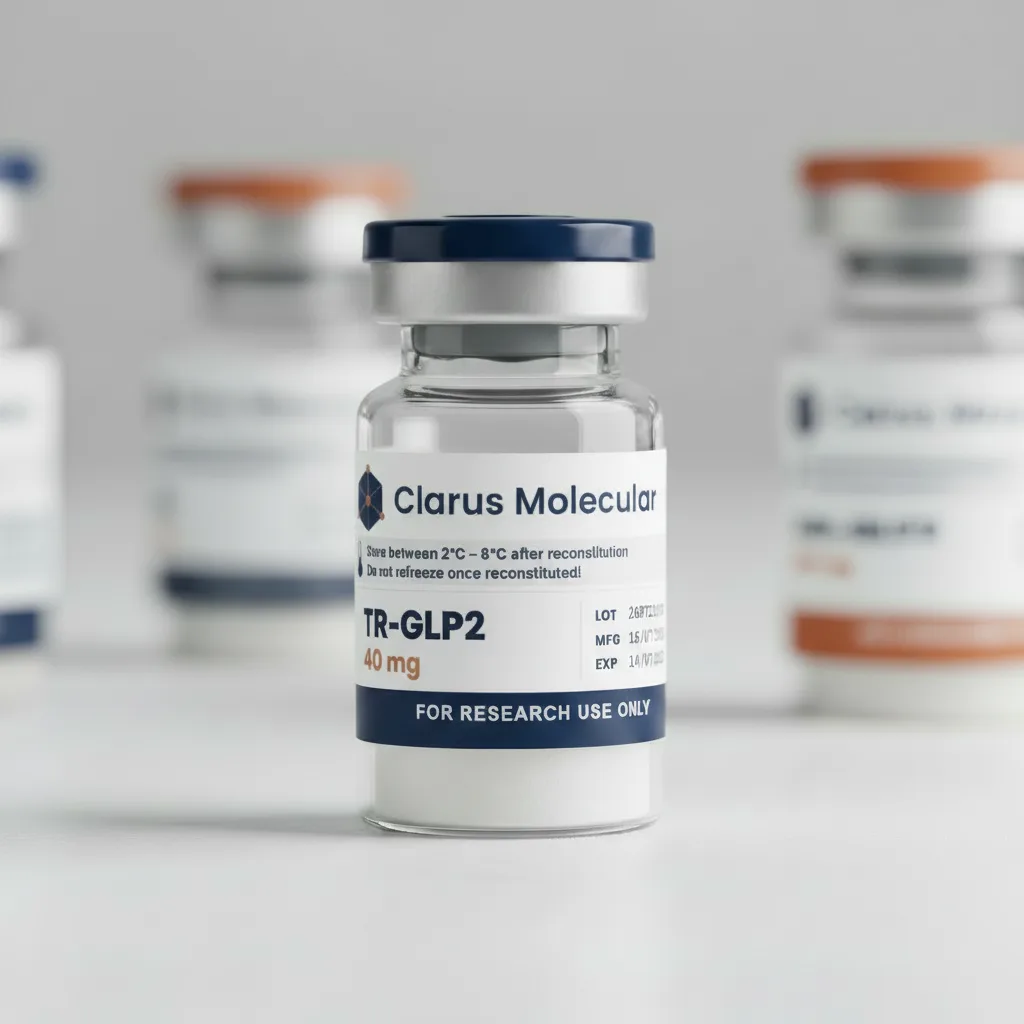
How tirzepatide’s dual GIP/GLP-1 mechanism works, and the SURPASS/SURMOUNT Phase 3 trial data behind Mounjaro and Zepbound.
What it is studied for
- Dual GIP/GLP-1 receptor agonist — the mechanism behind Mounjaro and Zepbound
- Up to 22.5% mean body-weight reduction at the highest dose in the SURMOUNT-1 trial
- HbA1c reductions of up to 2.58% across the SURPASS trial programme
- Compared head-to-head against single-receptor GLP-1 agonists for glycaemic control and weight loss
Areas of published research interest. Not claims of effect, and not medical guidance.
What it is
TR-GLP2 is our coded name for Tirzepatide — a dual GIP/GLP-1 receptor agonist and one of the most extensively studied incretin compounds in the literature, developed by Eli Lilly and marketed as Mounjaro (FDA-approved May 2022, for type 2 diabetes) and Zepbound (FDA-approved November 2023, for chronic weight management). The UK's MHRA has separately approved it for type 2 diabetes, with the weight-management indication still under evaluation there. Those approvals are for the branded product, used under medical supervision; this vial is a research compound, sold for laboratory research use only.
Structurally, tirzepatide is a synthetic peptide of around 39 amino acids carrying a C20 fatty-diacid side chain attached via a linker at a lysine residue, with an alpha-aminoisobutyric acid (Aib) substitution at position 2 for DPP-4 resistance. That fatty-acid modification enables albumin binding, giving the molecule a research half-life of approximately 5 days and supporting once-weekly dosing — peak plasma concentrations occur roughly 8 to 72 hours after injection.
In the research literature
Tirzepatide's dual agonism is built on a deliberately imbalanced potency profile: it is reported at roughly 5-fold greater potency at the GIP receptor relative to native GIP, while carrying only about 0.2-fold the potency of native GLP-1 at the GLP-1 receptor. GLP-1 receptor activation enhances glucose-dependent insulin secretion, suppresses glucagon, slows gastric emptying, and reduces appetite through hypothalamic signalling. GIP receptor activation potentiates insulin secretion on its own, and researchers report it may improve lipid metabolism and fat distribution and enhance central appetite regulation. The combination is reported to produce greater glycaemic and weight effects than either receptor pathway alone — the synergy that distinguishes a dual agonist from a GLP-1-only compound like semaglutide.
Tirzepatide and retatrutide are close structural relatives — both roughly 39-amino-acid, GIP-backboned, Aib-stabilised peptides from the same manufacturer, both dosed once weekly. The two differ in exactly the place that matters mechanistically: tirzepatide's C20 fatty diacid sits at a different lysine position than retatrutide's C18 chain, and tirzepatide's glucagon-receptor activity is negligible where retatrutide's is a potent, deliberately engineered third target. That one structural difference is why tirzepatide is studied as a dual agonist and retatrutide as a triple agonist, despite the two molecules sharing most of their design. See our Retatrutide research profile for the equivalent breakdown of that compound.
Tirzepatide sits inside two of the largest Phase 3 development programs run in metabolic medicine: SURPASS, in type 2 diabetes, and SURMOUNT, in obesity and overweight. SURPASS-1 (Rosenstock J et al., Lancet 2021; PMID 34186022) — a double-blind, randomised Phase 3 trial in treatment-naive type 2 diabetes — reported HbA1c reductions of 1.87%, 1.89% and 2.07% against 0.04% on placebo across its three dose groups, body-weight reductions of 7.0 to 9.5 kg across those same dose groups, and up to 52% of participants at the 15 mg dose reaching an HbA1c below 5.7%.
SURMOUNT-1 (Jastreboff AM et al., N Engl J Med 2022; PMID 35658024) — the trial that established tirzepatide's weight-management case — reported mean weight reductions of 15.0%, 19.5% and 20.9% against 3.1% on placebo at 72 weeks across its three dose groups, with up to 36% of participants on the 15 mg dose achieving 25% or greater weight loss. A follow-up trial, SURMOUNT-2, extended the same weight-management question into a population that also had type 2 diabetes, and the wider SURPASS and SURMOUNT programs between them represent one of the largest Phase 3 datasets in the metabolic-peptide field, which is part of why tirzepatide is treated as a reference point when evaluating newer compounds like retatrutide.
Because tirzepatide requires medical supervision as a prescription medication in its approved form, and because it carries an FDA boxed warning, dose escalation in the trials above followed a fixed titration schedule specifically to limit gastrointestinal side effects — the same schedule this page's typical research dose is drawn from. The safety findings behind that boxed warning, and the compound's contraindications, are covered in full on the product page rather than summarised here.
Common questions
Is this the same as Mounjaro or Zepbound?
How is tirzepatide different from retatrutide?
Available doses
Every dose is priced and stocked on one product page — select the one you want there.