Reconstitution & Storage Guide
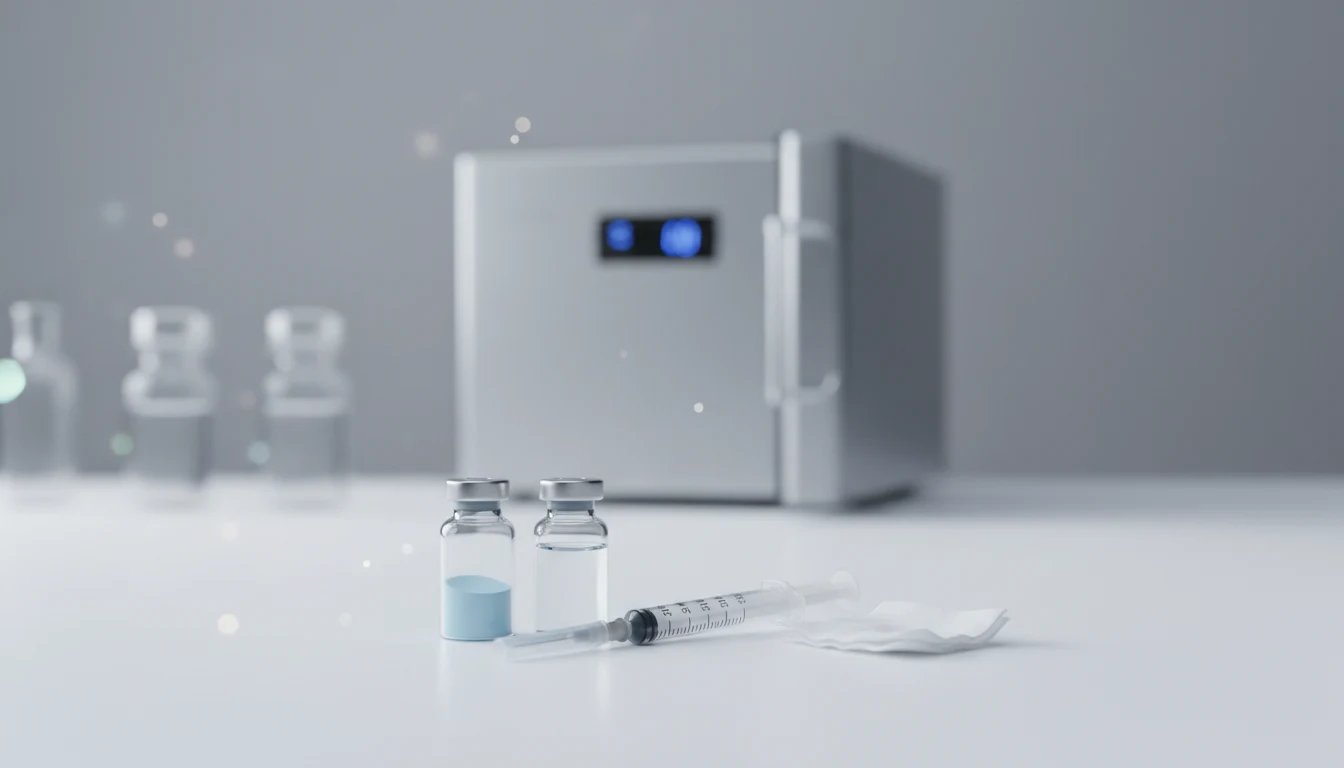
Choosing a solvent, working out the concentration, handling the vial without damaging the peptide, and what storage temperatures actually buy you before and after reconstitution.
What reconstitution is
Peptides ship lyophilised because the dry form is stable. Reconstitution is the step that turns that solid back into a solution of known concentration, and it is the point at which two things become fixed: how concentrated the material is, and how long it will remain usable.
Neither is recoverable afterwards. Adding too much solvent cannot be undone, and a vial reconstituted with the wrong solvent cannot be rescued. It is worth being deliberate about a step that takes two minutes.
Choosing a solvent
Two solvents cover almost all research peptides, and the product page for each compound states which one applies.
Bacteriostatic water
Sterile water containing 0.9% benzyl alcohol, which suppresses microbial growth. This is the default for the large majority of peptides and the reason a reconstituted vial keeps for weeks rather than days. Plain sterile water works chemically but offers no bacteriostatic protection, so it shortens usable life considerably.
Dilute acetic acid
A small number of peptides — typically those that aggregate or dissolve poorly at neutral pH — reconstitute properly only in a mildly acidic solution. Where that applies, the product page says so explicitly. Using water on a peptide that needs acetic acid usually shows up as material that will not fully dissolve, and forcing it does not help.
The arithmetic
Concentration is the whole of it:
Concentration (mg/mL) = peptide in the vial (mg) ÷ solvent added (mL)
A 10mg vial reconstituted with 2mL of bacteriostatic water is 5mg/mL. The same vial with 1mL is 10mg/mL. The quantity of peptide never changes — only how thinly it is spread, and therefore what volume corresponds to a given amount.
On a standard U-100 insulin syringe, 100 units is 1mL, so a volume in millilitres multiplied by 100 gives the marking to draw to. Our reconstitution calculator does all of this in both directions, including the useful inverse: how much solvent to add to make a given amount land on a convenient marking.
There is no universally correct volume. More solvent gives finer resolution on the syringe at the cost of a larger draw; less gives smaller draws that are harder to measure accurately. Most researchers settle on whatever puts their working amount somewhere in the middle of the barrel.
Handling the vial
- Let a cold vial reach room temperature first. Condensation on cold glass introduces water where you have not accounted for it.
- Add the solvent slowly, down the inside wall of the vial. Directing a jet straight onto the peptide film is unnecessarily harsh.
- Swirl gently, or leave it to stand. Do not shake. A peptide works because of the shape it folds into, and that shape is held together loosely enough that shaking a vial — and the foam it whips up — can pull it apart. Some take several minutes to go fully into solution; that is normal and waiting costs nothing.
- Look at the result. A properly reconstituted solution is clear. Persistent cloudiness, visible particles, or material that will not dissolve after standing are all reasons to stop and check the compound's stated solvent.
- Label the vial immediately with the concentration and the date. A vial of clear liquid carries no information about itself, and a fortnight later neither will you.
Storage
Every product page carries a storage table for that specific compound, split into unreconstituted and reconstituted. As general orientation:
Unreconstituted, lyophilised. Cool and dark is the requirement, and colder is better for anything held long term. Kept properly, the dry form is stable over a period measured in years rather than weeks. Room temperature is tolerable for the days a shipment spends in transit, which is why cold-chain shipping is not normally necessary.
Reconstituted, in solution. Refrigerated, and used within the window stated for that compound — typically a few weeks with bacteriostatic water. Repeated freeze-thaw cycles are the thing most worth avoiding: each one is a stress on the molecule, so aliquoting before freezing is preferable to thawing and refreezing a single vial.
Light and heat. Both degrade peptides in solution. Vials belong in their box in the fridge, not on a shelf or a windowsill.
Record-keeping
Worth keeping alongside the vial: the compound and batch, the date of reconstitution, the solvent used, the volume added, and the resulting concentration. It takes one line and it is the difference between a characterised material and an unknown one — which is the entire distinction this category rests on.